
Self-initiated concept · case study and technical teardown

Interactive 3D Watch Product Page

A five-act experiment in turning one premium product page into the launch story, live demonstration, material configurator, and campaign surface.

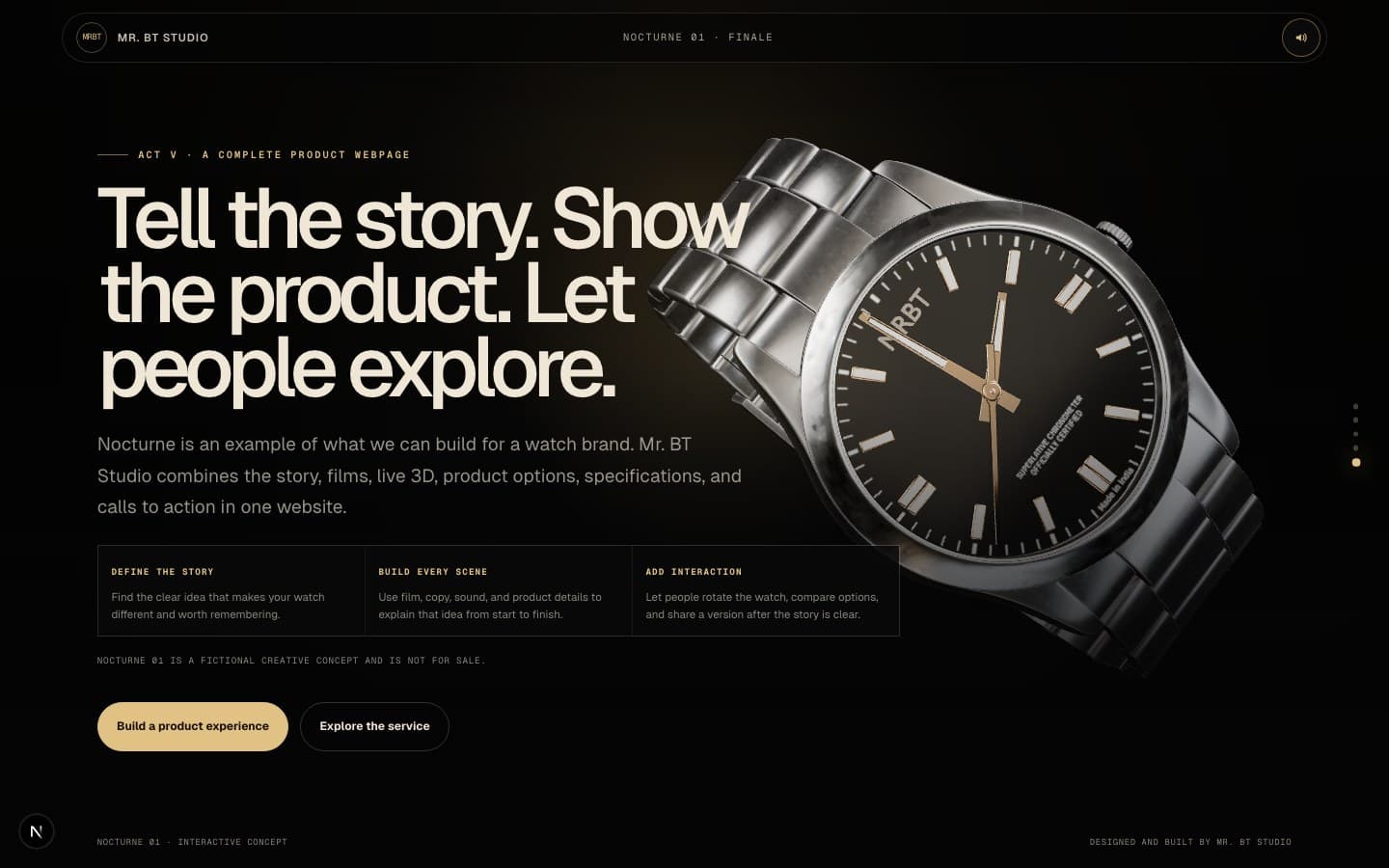
Final act of the interactive watch product page
The product-page problem

Show value before asking for a choice.

Premium products are often reduced to a gallery, a specification table, and a selector. That makes the buyer assemble the story, material differences, and product logic on their own.

This concept tests a different structure: let cinematic media establish desire, move into live inspection when interaction is useful, then reveal configuration only after the visitor understands the product.

Experience architecture

Five acts, each with one job.

  1. Act I

    Arrival

    A cinematic opening establishes the product, tone, and fictional concept before asking the visitor to interact.

  2. Act II

    Craft

    Two connected beats move from the material story into closer live inspection. They remain one intentional act.

  3. Act III

    Campaign

    A focused media lab shows how one product system can support multiple launch directions and formats.

  4. Act IV

    Configure

    The visitor compares finishes, changes the view, and shares a configuration without leaving the page.

  5. Act V

    Finale

    The product story resolves into a clear explanation of the studio capability and useful next steps.

Live 3D and configuration

Film hands over to something the visitor can use.

Authored film establishes the watch and then dissolves into a live GLB scene. The same browser page carries the handoff, so a visitor can move from a directed story into product inspection without opening a separate viewer.

Inspect the product

The live scene supports rotation, orbit and zoom controls, plus hero, detail, and profile views. Camera and material states are coordinated with the films so the transition does not discard the visitor's chosen setup.

Compare and keep a choice

Presets and part-level controls change the concept case, bracelet, dial, accent, and glass. The selected configuration can be encoded in a shareable URL or captured as an image. These options are fictional interface data, not purchasable variants or a commerce integration.

Media and provenance

Every study says what kind of image it is.

The arrival and finale films, plus two Campaign Lab studies, are presented as CG renders. Three further Campaign Lab studies are labelled “AI-generated concept” where they appear in the live interface.

Nocturne 01, its specifications, the product story, and all campaign directions are fictional. None of this material was supplied or approved by a client, and no real product launch or outcome is represented.

Role, tools, and deliverables
Role
Mihir Botle led this self-initiated concept: experience direction, art direction, interaction design, browser implementation, responsive and accessibility behaviour, performance work, testing, and integration of the existing visual and media package.
Tools
Blender, Next.js, React, TypeScript, GSAP, Three.js through React Three Fiber, CSS, Playwright, axe-core, and Lighthouse.
Deliverables
A five-act browser experience, responsive cinematic-media system, live 3D product viewer, finish configurator, share and screenshot actions, accessible fallback paths, release tests, and this combined buyer case study and technical teardown.
What the build taught us

The difficult parts sit between the media.

Scroll is an input, not a timeline

Fast trackpad movement, touch inertia, keyboard navigation, and reverse scrolling all produce different signals. The experience therefore uses explicit act state, bounded progress, and reversible transitions instead of assuming a perfect downward scroll.

Film and WebGL need a shared contract

Camera position, product state, hand angles, lighting, and transition timing have to meet at authored boundaries. A typed manifest keeps those decisions out of individual components.

Mobile needs its own interaction policy

The phone experience prioritises native vertical scrolling, compact controls, responsive media families, reduced-motion behaviour, and an explicit Save-Data path rather than shrinking the desktop interaction.

Failure states are part of the design

Posters, last decoded frames, no-WebGL behaviour, document visibility, and optional 3D loading prevent a broken decoder or unavailable graphics context from turning the page into a blank screen.

Performance and accessibility

A cinematic page still has to behave like a webpage.

The first mobile audit exposed excessive early media, long main-thread work, and controls that were too small. Those are release blockers, not details to hide behind the visual result.

The current implementation selects a responsive media family, defers live 3D, preserves native mobile scrolling, provides reduced-motion and Save-Data behaviour, and keeps poster or decoded-frame fallbacks available when richer media fails.

Release checks

  • • One responsive video family requested per device.
  • • Keyboard-accessible acts and configurator controls.
  • • 44px progress and primary interaction targets.
  • • Reduced-motion, Save-Data, no-WebGL, and media-failure paths.
  • • Repeat traversal reuses media rather than re-downloading it.
What changes for a client project

The interaction system stays; the evidence becomes real.

This concept is proof of capability, not a ready-made template or a promise of a fixed scope. A commissioned page would be defined around the product, buyer decision, approved inputs, and delivery environment.

  1. Stage 1Discovery and a light asset review would confirm the commercial brief, available CAD or 3D inputs, approved product information, media permissions, target devices, and the decisions the page needs to support.
  2. Stage 2The fictional finishes, specifications, copy, and campaign studies would be replaced by approved product data and brand material, with review gates for story, product accuracy, interaction, and responsive behaviour.
  3. Stage 3Commerce, product-data, analytics, localisation, and content-management connections would be scoped against the client's real systems instead of being implied by the concept build.
  4. Stage 4The proposal and statement of work would name deliverables, review rounds, acceptance checks, ownership, handoff, and scope-change handling before production begins.
What this proves

One browser page can carry the product story and the product tool.

It proves the studio can design and engineer this interaction system. It does not prove commercial performance. That would require a real launch, analytics, and permission to publish the outcome.